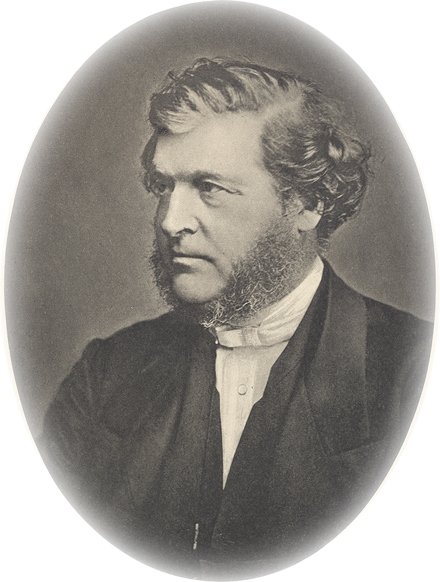
It may surprise some of our readers to find these two men linked in a title, but to us there is nothing odd. We have been reading Wesley nearly as long as we have been reading Calvin, and indeed our first volumes of Calvin, the two volumes of his Commentary on Genesis in the Calvin Translation Society edition of 1850, came from the library of the Wesleyan theological Institution (latterly Richmond College), Richmond, Surrey (bookplate illustrated). So the two men are quite linked in our mind.
We are not of the sort of men who can make a sermon out of the commentaries of others, yet the commentaries we have most often consulted are those of Calvin and the Notes on the New Testament of John Wesley.
Theologically, of course, we are closer to John Calvin than to Wesley, but we would maintain that we are second to no Wesleyan in our admiration for Mr. John Wesley as a man and a preacher. We are not Romanist, but we maintain that there are few more hallowed places in England than a certain place on the City Road in London, where Wesley's chapel faces Bunhill Fields across the road. If there is a place of Protestant pilgrimage in London, it is that place. We have often visited that place, and knelt in silent prayer in the little courtyard under which lie the mortal remains of John Wesley, 'in sure and certain hope of the resurrection of life.'
We have preached in a Wesleyan chapel and a presbyterian church. Calvin and Wesley are a part of our life and our Christian heritage.
Why Wesley and Calvin? We feel that both men have been largely treated in the same way, either whitewashed or vilified in general. They are great men, but neither saints nor monsters. As with all great men their faults were great as well as their virtues, and so their admirers have commonly seen only their virtues, whilst their detractors have only seen their faults. Both men await standard biographies that will portray them as they were, as men.
Wesley and Calvin were very different men in many ways, not simply doctrinally. Calvin was a reticent, quiet man who rarely talked about himself, and whose life is therefore often quite difficult to chronicle, he suffered from ill-health, and was happily married, though for too short a time. He died at a relatively early age. Wesley, on the other hand, recorded his life in great detail and enjoyed amazingly good health until his last years. Wesley's marriage was a complete disaster, and he died at a ripe old age. Calvin's work was done while based in one place, while Wesley travelled throughout the British Isles. And Wesley, of course, was an Arminian of a type (there are different kinds of Arminian).
We hold, having read all the writings of John Wesley and most of those of Calvin, that both men were true Christians. But Wesley's mind had been poisoned against Calvinism, which he seems never to have understood correctly. He thought that Calvinists believed that "the elect shall be saved do what they may, the reprobate shall be damned, do what they will." No Calvinist has ever held this. We hold that the elect are called to good works, to sanctification, and that the reprobate are damned for their own sins.
John Wesley's theology, as found in his collected works, is simply not integrated. In the face of those who said that Divine providence was simply general, he taught that God's providence was particular, and asked sagely "what is a general without particulars?" Well, is not Wesley right? So what is a 'general' election of a class without particular election of the members of that class? What is a general redemption unless it is the redemption of particulars? Wesley's logic demolishes his Arminianism. We have often quoted him in preaching as our Arminian interlocutor, in order to avoid the objection that we shoot at a straw man in our responding to free-will teaching.
In Calvin's case, we agree with the marrow of his doctrine whilst condemning some of the things he did, most notably in the Servetus case. In Wesley's we agree with much of what he did whilst dissenting from his Arminianism and perfectionism. No-one is perfect, and Wesley's theology is a muddle, not a system.
Calvinism has been charged with encouraging a morbid introspection, but Wesley could be as morbidly introspective as any Puritan. His doctrine of 'Christian perfection' (which is a perfect mess and quite unintelligible, even after multiple readings) led him to condemn himself in the most amazing terms:
In one of my last [letters] I was saying that I do not feel the wrath of God abiding on me; nor can I believe it does. And yet (this is the mystery), I do not love God. I never did. Therefore I never believed, in the Christian sense of the word. Therefore I am only an honest heathen
Wesley was faced by men who had never known the sinfulness of their own hearts, saying that THEY were sinless. And his guileless soul believed them, which plunged him into this deep depression.
It is this very experimental knowledge of the sinfulness of sin that convinces us that Wesley was a true Christian. He speaks not as the hypocrite, but as Paul does when he cries out "Oh wretched man that I am! Who shall deliver me from the body of this death?" Had Wesley ever claimed to be perfect, then we would have doubted his salvation indeed!
We have the portraits of Calvin and Wesley on our wall. There we shall keep them, as we keep their writings. And from the lives of both we shall continue to draw encouragement and challenge.