Friday, May 15, 2009

The Wit of the Irish Methodist - C.H. Kelly. A Case of Mistaken Identity


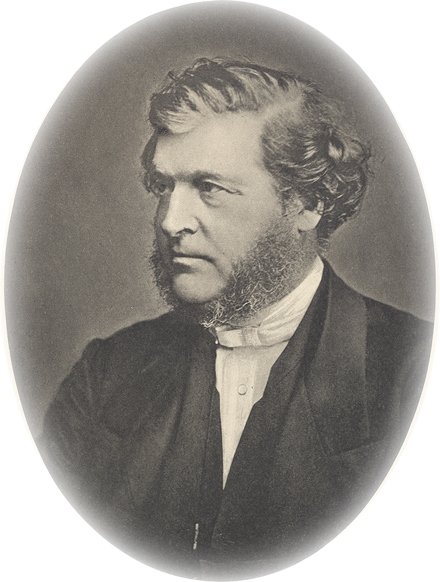
C.H. Kelly bore an uncanny resemblance to a couple of other ministers who were more prominent at the time. One of them was the Rev. Newman hall, pastor of Surrey Chapel, Lambeth, and later Christ Church, Westminster Bridge Road.
"It is well known that Mr. Newman Hall obtained a divorce from his wife. Soon after an effusive man rushed up to me at Blackfriars [station], 'Oh, I do congratulate you most heartily on your success in the court!' said he. I suppose he saw I was puzzled. 'I mean about your divorce!' Then he realised his mistake, apologized, and rushed off like a cannon-ball."
Mr. Kelly, of course, was happily married at the time!

Thursday, May 14, 2009

The Wit of the Irish Methodist - C.H. Kelly. Hymns and their alterations.


Charles H. Kelly was a Methodist minister in the 19th century. He was twice president of the Wesleyan Methodist Church, but more importantly, he was the Book-Steward of the Wesleyan Church, in other words, head of the denominational publishing office. His Memories (London, Robert Culley, 1910), is full of wonderful anecdotes. God willing, I hope to present some of them here.
Kelly was a member of the committee that revised John Wesley's hymn-book in the 1870s. He gives one story that might have some point today as well:

In the committee of the 1877 book one prominent minister not only opposed the exclusion of any of Charles Wesley's hymns that had found place in the previous edition, but also almost every verbal alteration that was suggested. There was a peculiar incident. The word 'bowels' often appeared. When one verse was read, perhaps the youngest member said, "Bowels again! We can at least change here for 'mercies.'" Said the old warrior somewhat scornfully: 'We are so fine now, I suppose we are not to be allowed to have bowels!" The reply was sharp. "I have no objection against Dr. ------ having bowels, but a very strong one against them protruding." The word was altered.
C.H. Kelly, Memories (London, Robert Culley, 1910)

Wednesday, May 13, 2009

Wisdom from Tozer - Watch those sermon titles!


"A preacher not long ago announced that he would have for his subject next
Sunday 'Don't tear your shirt." He took for his text these words, 'Rend your hearts and not your garments,' and preached on repentance. It is that kind of thing that makes atheists. To approach a solemn subject in such a flippant manner is inexcusable. It is time the Christian public goes on a gracious and dignified strike against such comic-strip parody of Gospel preaching."


(James Snyder: A.W. Tozer: In Pursuit of God (Monarch, 2009) Pp. 81-2

Tuesday, May 12, 2009

Wisdom from Tozer - You need to go to Church!


"Once he encountered a man who did not believe in going to church each week to hear the Word of God preached. The man felt that once people were converted, they should immediately turn their full attention to winning others. 'A farmer,' the man argued, 'candles his eggs once, not every week. As soon as the eggs have been candled, he crates them and ships them off to market.'
"Tozer found a serious flaw in the man's argument. 'Christ did not say to Peter, "Candle my eggs," He said, "Feed my sheep." Christians are not eggs to be candled but sheep to be fed. Feeding sheep is not something you do once for all. It is a loving act you repeat regularly as long as the sheep live.'"
(James Snyder: A.W. Tozer: In Pursuit of God (Monarch, 2009) Pp. 98-9

Monday, May 11, 2009

A.W. Tozer: in Pursuit of God

Following the release of Lyle Dorsett's excellent biography of Tozer A Passion for God, this older biography of Tozer (first published in 1991) by James L. Snyder has been put out in an attractive paperback edition. I was at first concerned that this was simply an attempt to answer Dorsett's criticisms of Tozer's married life. But it was an unworthy suspicion. Arthur Porritt described William Adamson's biography of Joseph Parker as "A four-hundred page essay in incense-burning." This book is something else, it is a well-written biography that tries to present a picture of Tozer as he was, warts and all. The shape of the work is slightly different from Dorsett's, and one who has already read Dorsett will certainly get something out of Snyder's work.
Snyder gives an excellent account of the life and ministry of A.W. Tozer in this book. Each chapter ends with a section of 'Tozer-grams', brief, pithy quotations from Tozer, a feature I feel sure that many readers will appreciate. Snyder opens with an introduction entitled 'The Art and Stealth of Christian Biography', in which he lays out the pitfalls of Christian biography and describes Tozer's own philosophy of biography, opening with the temptation to leave out the subject's faults. There is of course the opposite tendency in some cases - the hostile biography in which the subject's virtues are obscured. Calvin is the most notable victim of this tendency, but there are biographies of others that do the same. This requires the rest of the book to live up to this aim - no bad thing!
Snyder's book is a popular, rather than a scholarly, work, but none the worse for that. Not all Christians are willing to read a book with eight pages of endnotes, after all! What is apparent, however, is that a great deal of patient research has gone into this popular-level biography. In our Church reading group at Tabor Baptist Church several of the members have complained about biographies that don't have pictures of the subjects. There would be no such complaints about this book - it has eight pages of black-and-white pictures in it.
What the reader will find here is Tozer in all his devotedness and eccentricity. The reader with a sense of humour will probably latch on to some of the eccentricity stories, but will deeply appreciate the devotedness of Tozer. A.W. Tozer was a man of prayer and study. He disliked the superficial 'now I am happy all the day' brand of Christianity, and refused to mistake religious busyness for the work of the Holy Spirit. He courageously denounced antinomianism, and refused to limit himself to the narrow limits of his own denomination.
A.W. Tozer: In Pursuit of God, by James L. Snyder, is published by Monarch Books, and is available from your local Christian bookshop. It retails at £8.99.

Saturday, May 9, 2009

Wit and Wisdom from G.K. Chesterton - 2

"What we suffer from to-day is humility in the wrong place. Modesty has moved from the organ of ambition. Modesty has settled upon the organ of conviction; where it was never meant to be. A man was meant to be doubtful about himself, but undoubting about the truth; this has been exactly reversed. Nowadays the part of a man that a man does assert is exactly the part he ought not to assert - himself. The part he doubts is exactly the part he ought not to doubt - the Divine Reason." - Orthodoxy P. 235

Tuesday, May 5, 2009

Wit and Wisdom from G.K. Chesterton - 1.

I am just reading my copy of the first volume of the Ignatius Press edition of the works of G. K. Chesterton. While I am far from agreeing with Chesterton on all things, I find his insight into post-Christian culture extremely articulate and intelligent. So I shall post some of the better quotation here. All page number are of course from the Ignatius Press edition (San Francisco, 1986)

On the use of language to avoid important questions:
"Every one of the popular modern phrases and ideals is a dodge in order to shirk the problem of what is good. We are fond of talking about "liberty"; that, as we talk of it, is a dodge to avoid discussing what is good. We are fond of talking about "progress"; that is a dodge to avoid discussing what is good. We are fond of talking about "education"; that is a dodge to avoid discussing what is good. The modern man says, "Let us leave all these arbitrary standards and embrace liberty." This is, logically rendered, "Let us not decide what is good, but let it be considered good not to decide it." He says, "Away with your old moral formulae; I am for progress." This, logically stated, means, "Let us not settle what is good; but let us settle whether we are getting more of it." He says, "Neither in religion nor morality, my friend, lie the hopes of the race, but in education." This, clearly expressed, means, "We cannot decide what is good, but let us give it to our children.""
-Heretics P. 51

On Utopianism:

"Mr. [H.G.] Wells, however, is not quite clear enough of the narrower scientific outlook to see that there are some things which actually ought not to be scientific. He is still slightly affected with the great scientific fallacy; I mean the habit of beginning not with the human soul, which is the first thing a man learns about, but with some such thing as protoplasm, which is about the last. The one defect in his splendid mental equipment is that he does not sufficiently allow for the stuff or material of men. In his new Utopia he says, for instance, that a chief point of the Utopia will be a disbelief in original sin. If he had begun with the human soul--that is, if he had begun on himself--he would have found original sin almost the first thing to be believed in. He would have found, to put the matter shortly, that a permanent possibility of selfishness arises from the mere fact of having a self, and not from any accidents of education or ill-treatment. And the weakness of all Utopias is this, that they take the greatest difficulty of man and assume it to be overcome, and then give an elaborate account of the overcoming of the smaller ones. They first assume that no man will want more than his share, and then are very ingenious in explaining whether his share will be delivered by motor-car or balloon." - P. 77


On accomodation to the trends of the time:
"When modern sociologists talk of the necessity of accommodating one's self to the trend of the time, they forget that the trend of the time at its best consists entirely of people who will not accommodate themselves to anything. At its worst it consists of many millions of frightened creatures all accommodating themselves to a trend that is not there. And that is becoming more and more the situation of modern England. Every man speaks of public opinion, and means by public opinion, public opinion minus his opinion. Every man makes his contribution negative under the erroneous impression that the next man's contribution is positive. Every man surrenders his fancy to a general tone which is itself a surrender. "
P. 101