Saturday, August 16, 2008

Critics of Lakeland 'Revival' Vindicated

Our deep suspicion of Todd Bentley has been further vindicated by the news that this supposed 'Man of God' is to separate from his wife. The false revival at Lakeland in Florida is over, and as the post mortem examination begins, the great question that Charismatics are asking is: "How could we be so gullible?" Here is a good example:

"Why did God TV tell people that “any criticism of Todd Bentley is demonic”?

This ridiculous statement was actually made on one of God TV’s pre-shows. In fact, the network’s hosts also warned listeners that if they listened to criticism of Bentley, they could lose their healings.

This is cultic manipulation at its worst. The Bible tells us that the Bereans were noble believers because they studied the Scriptures daily “to see whether these things were so” (Acts 17:11, NASB). Yet in the case of Lakeland, honest intellectual inquiry was viewed as a sign of weakness. People were expected to jump first and then open their eyes.

Just because we believe in the power of the Holy Spirit does not mean we check our brains at the church door. We are commanded to test the spirits. Jesus wants us to love Him with our hearts and our minds.

Because of the Lakeland scandal, there may be large numbers of people who feel they’ve been burned by Bentley. Some may give up on church and join the growing ranks of bitter, disenfranchised Christians. Others may suffer total spiritual shipwreck. This could have been avoided if leaders had been more vocal about their objections and urged people to evaluate spiritual experiences through the filter of God’s Word."


We have been deeply suspicious of the movement since we first heard of Bentley's claims, since we tend to treat claims of revival with caution. An examination of Bentley's teaching and behaviour convinced us that this was not the real thing, and so when Justin Peters reported that Lakeland 'healings' were nothing of the kind, we merely nodded and prayed for those who were thus deceived. And it wasn't only people in the Charismatic churches. God willing, this coming Lord's Day we shall be attending the chapel where we first heard of Todd Bentley and the goings-on in Lakeland. We may have some words of advice for friends.

John Piper has a good article on the subject. His advice to test claims of Revival with doctrine must be heeded.

While we applaud the editors of Charisma magazine, we have to ask, why did it take Bentley's marriage breaking down for them to print a critique of the man that was true whether or not he separated from his wife?

Let us also praise God that He has taken this false prophet out of the way. And let us pray that Bentley will repent of his spiritual wickedness.

We were alerted to these articles by Rhett of Rhett's Rants.

Tuesday, August 12, 2008

A Refreshing change from Lambeth

For those readers who have read of the total failure of the Anglican Communion to decide anything on the question of homosexuality, we would recommend this paper produced by the Committee on Doctrine of the United Free Church of Scotland in 1995. This is how to deal with the issue - Biblically. What does the Bible say?

Our own favourite point of this document was this comment:
"c) 1 Samuel 18: 1, 20:30

These verses have been adduced as evidence in support of the claim that the much vaunted friendship between David and Jonathon was a homosexual relationship. There is, however, no hint of erotic behaviour in the Biblical text and the 'shame' described in 20:30 related to Jonathon's [sic] disloyalty to his father and family when siding with David against Saul. Indeed it was the Panel's view that the current preoccupation with homosexuality could devalue and cast unnecessary suspicion upon those wholesome relationships that are possible between same-sex friends."

Friday, August 8, 2008

'Correct' Spelling and the 1611 AV


A recent news report on the BBC caught our attention. A university lecturer, fed up with having to correct spelling mistakes, has suggested that English might be relaxed to allow some variation in spelling. This immediately causes us to think of the 1611 Authorised Version of the Bible that we have. Not an actual 1611 printing, we hasten to add, but the 1911 reprint. Back in 1611, English spelling was quite fluid, and as long as a word sounded right, the spelling was fine. Would it really be so bad to go back to the 17th century in this respect?

We give some examples chosen at random:

Number 34. 21: "Sonne" for 'Son'

Numbers 35.7: "Fourty" for 'Forty'

Exodus 4.4: "And the LORD said unto Moses, Put Forth thine hand and take it by the taile: and he put foorth his hand, and caught it." Note two different spellings of 'forth', and the 'e' on the end of 'tail'

Exodus 4.8: "And it shall come to passe, if they will not beleeve thee, neither harken unto the voice of the first signe, that they will beleeve the voice of the latter signe." Note spellings of 'pass', 'believe' and 'sign'

Exodus 4.9: "Powre" for 'pour'

John 3.7: "Marveile" for 'marvel'

John 3.11: "Verely, verely I say unto thee, we speake that we doe know, and testifie that wee have seen; and yee receive not our witnesse." Note that the number of 'e's in 'we' is a matter of indifference, the same is true of 'ye', and of any word with a terminal letter 'e'. The letter 'e' can be added to the end of a word or not, depending on how the writer feels. Note also variant spelling of 'testify'.

John 4.25: "Commeth" for 'cometh'

John 4.30: "Citie" for 'city'

2 Corinthians 810: "Yeere" for 'year'

Our intention is not to make fun of the 1611 AV. No, we quote it to add to the debate on how strict spelling rules ought to be. Would it really hurt to allow all these wonderful 17th century spellings to be used in modern English?


For those Americans interested in our spelling, we advise popping over to the BBC website here.

Wednesday, August 6, 2008

Todd Bentley 'fire' cooling

It seems that false prophet Todd Bentley's attempts to spread his strange fire through America have fallen a little flat. We pray that these failures will lead to his planned visit to the United Kingdom being cancelled.

We first heard of Bentley when he was praised from the pulpit (well, not the pulpit, it wasn't being used) of a chapel that we have preached from. Rather than instantly condemning the 'healings' when we heard of them, we looked into the Lakeland 'revival', and held back until we had certain proof that the screaming tattooed man who likes to kick sick people is a false teacher and a false prophet. We fist heard of him in connection with an alleged healing of a pastor with throat cancer. Since the man has not been healed, Bentley has given him false hope. The destruction of that false hope will be terrible, and we pray that it will not destroy the man who was told that he had been healed.

It is God's will that all of His people, save those who will be alive at the Second Advent, die. The cause of death will vary, but we will all, unless the Lord comes back first, die. We will all suffer sicknesses. God does not want us to live a healthy and wealthy life, he wants us to live a life of faith. Men like Todd Bentley undermine that faith when they falsely claim to speak for God.

Thursday, July 31, 2008

How to Criticize those we disagree with


Michael Haykin has written an excellent post over at the Andrew Fuller Centre on the subject of criticizing Andrew Fuller. A quotation used by Dr. Haykin in the post struck us as particularly apt:
“Once for all, we must enter our protest against that system of wholesale condemnation, that will admit of nothing good in a man, if some part of his divinity system happen to be open to question.”
This is excellent advice, especially as it comes from a critic of Fuller. We have begun serious study of John Calvin in preparation for a lecture that we shall be giving in Surrey, God willing, some time next year, and if ever there was a man concerning whom the wise words of this old book review whom Haykin quotes were often broken, it is the Reformer of Geneva. From Jerome Bolsec through every sort of silly Arminian and Romanist, to Dave Hunt and Nelson Price (from the ridiculous to.. the ridiculous), Calvin has been besieged by all sorts of men who have decided that, because they do not agree with Calvin's theology, he must have been the greatest monster who ever lived.

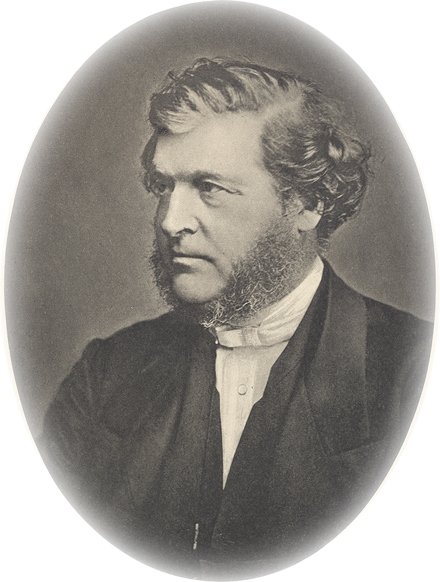
It was therefore refreshing to receive by post this morning Volume 2 of the Cambridge Modern History (first published in 1903), which contains a delightful essay on Calvin and the Reformed Church by Principal A.M. Fairbairn of Mansfield College, Oxford (pictured). A lifelong Arminian and forthright critic of Calvin's theology (let it never be said we only read biographies of Calvin by Calvinists!), Fairbairn nevertheless refused to ignore the good that Calvin had done. Of Fairbairn's essay, his biographer, W.B. Selbie, writes:
"In Calvin Fairbairn had a subject altogether to his mind, and his study of him is among the best things he ever wrote. He always distinguished between the man and his system. Of the latter he had been a convinced and determined critic from the earliest days of his ministry. But he always recognised the great part it had played in the development of Christendom, and he would never suffer the good that was in it to be forgotten. For the man he had a genuine admiration. In describing him as one whose mind was the mind of Erasmus, while his faith and conscience were those of Luther, he struck a point of affinity with himself that could not fail to win his sympathy." (The Life of Andrew Martin Fairbairn [Hodder and Stoughton, 1914] Pp. 403-4)
Like Arminius himself, he lauded Calvin's work as a commentator to the skies. Indeed, We doubt that any Calvinist has been so immoderate in praise of Calvin:
"His services to the cause of sacred learning must not be forgotten. These it is hardly possible to exaggerate; he is the sanest of commentators, the most skilled of exegetes, the most reasonable of critics. He knows how to use an age to interpret a man, a man to interpret an age. His exegesis is never forced or fantastic; he is less rash and subjective in his judgments than Luther; more reverent to Scripture, more faithful to history, more modern in spirit. His work on the Psalms has much to make our most advanced scholars ashamed of the small progress we have made either in method or in conclusions. And his work is inspired by a noble belief; he thought that the one way to realise Christianity was by knowing the mind of Christ; that this mind was to be found in the Scriptures; and that to make them living and credible was to make indefinitely more possible its incorporation in the thoughts and Institutions of man." (Cambridge Modern history, Vol. 2 P. 376)
And what Calvinist can disagree with this Arminian? It warmed our heart to know that Calvin's personality and skill as a commentator had won the sincere admiration and regard of the Oxford scholar.

Thursday, July 24, 2008

Tell the Minister!

Have you ever sat in a service and wanted to tell the minister afterwards that something he said confused you, or that you disagree with something he said? Probably. But have you actually done so? We do not mean in a mean-spirited, fault-finding way, but sincerely. If you have held back, we submit that you were wrong. Ministers need critics, not the nasty sort, but those who are genuinely concerned for the effectiveness of the Gospel ministry. We tend to develop bad habits over time, and it is only constructive criticism (we count personal remarks about the minister as out of court and unhelpful) that will allow us to spot these bad habits and correct them. So take care of your minister, and remember, unless he is completely self-centred and a fool, he will thank you for criticism. What he will not thank you for is holding back.

Despite rumours to the contrary, and claims by those who should know better, ministers are not pysychic. We do not know what you are thinking unless you tell us.

Wednesday, July 23, 2008

Servetus.


With the 500th anniversary of Calvin's birth approaching, we have been asked to give a lecture some time next year on John Calvin. In preparation for this we are searching out the facts of Calvin's life, not only in our own extensive library (more than 2'000 volumes, plus electronic versions of other works, including the complete works of Arminius and Calvin), but also online. An interesting article on Servetus is to be found here.